E-Bike Batteries: The Comprehensive Guide to Capacity, Range, and Lifespan
The e-bike battery (along with the motor) is the heart of every pedelec. It determines how far you can go on a single charge and how flexible you are on the road. Common capacity ratings are 500 Wh, 625 Wh, or 750 Wh—but what do these numbers actually mean? How long does an e-bike battery last, and what factors really influence the range?
This guide provides you with the most important facts about battery capacity, range, and lifespan —explained in a concise and easy-to-understand way. This will help you decide which e-bike battery capacity best suits your usage profile and how to get the most out of your e-bike’s battery performance.
How does an e-bike battery work?
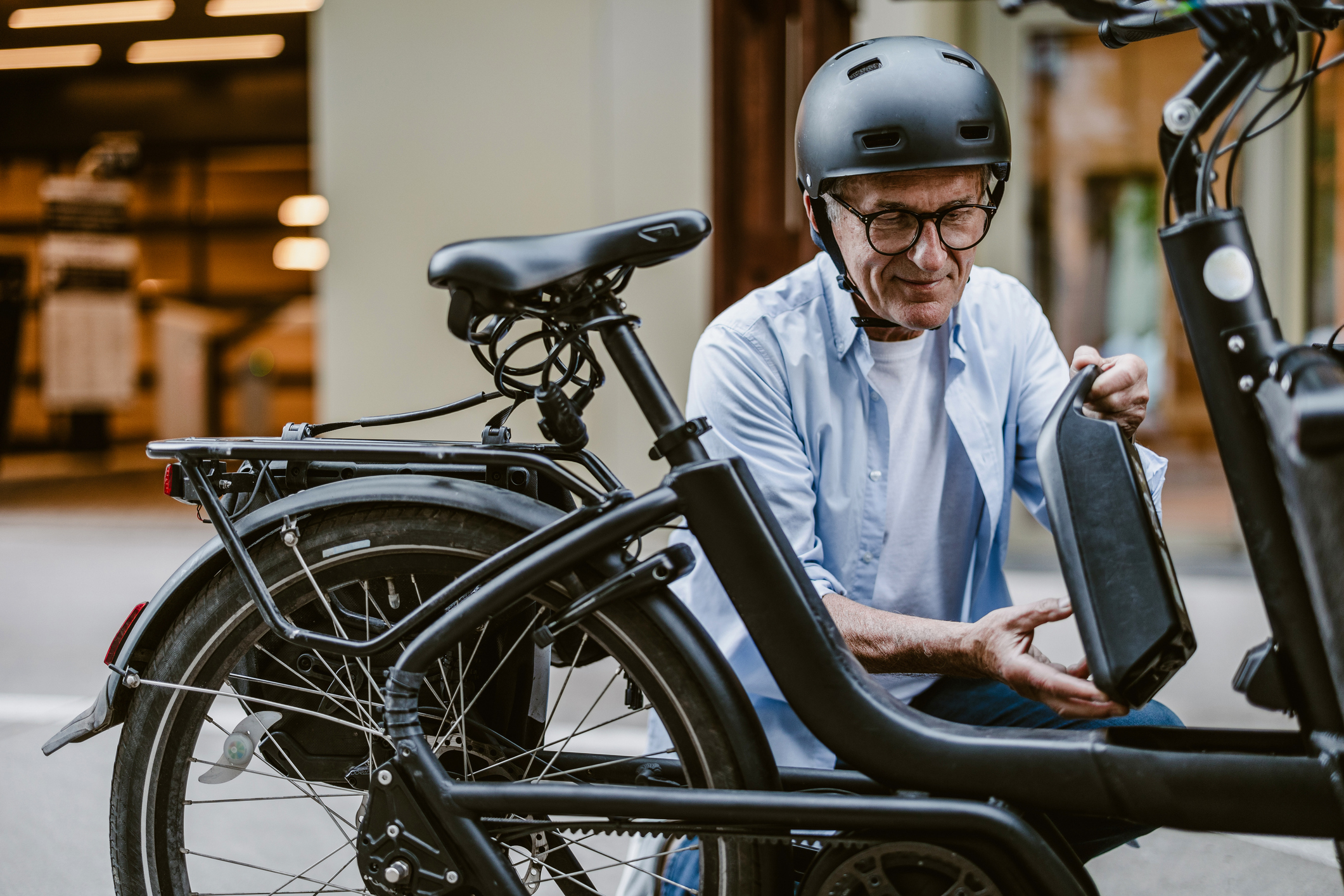
Typically, every electric bike battery consists of 28 to 60lithium-ion cells that store electrical energy and supply it to the motor as needed. These cells are housed in a sturdy casing: either on the frame, occasionally still on the rack, or—as is now the preferred option—integrated into the down tube (so-called “intube” batteries).
The battery's position plays a surprisingly important role: A battery mounted low and centrally improves the e-bike's center of gravity and, as a result, significantly enhances its handling.
Modern bike batteries are like tiny computers: An integrated battery management system (BMS) constantly monitors temperature, state of charge, and cell voltage to prevent overcharging and deep discharge. This means you can safely charge your bike battery even when it’s only partially discharged, without affecting its lifespan. (Old nickel-cadmium batteries always had to be fully charged, but that technology is now obsolete.)
E-Bike Battery Capacity: What Do Watt-Hours (Wh) Mean?
The unit watt-hour (Wh) indicates how much energy a bike battery can store. This is comparable to a car’s gas tank. A 500-Wh battery can theoretically deliver 500 watts of power for one hour. In practice, this means that the higher an e-bike’s battery capacity, the greater its theoretical range. In reality, however, the range depends on the motor’s energy consumption.
Overview of the Most Common E-Bikebattery sizes:
- 250 Wh: sufficient for e-bikes with hub motors or as an additional range extender
- 400–500 Wh: ideal for commuting and city riding
- 500–625 Wh: Standard for everyday use and touring
- 625–750 Wh: for long distances, mountains, and/or heavy loads
- 750–1,000 Wh: E-mountain bikes, cargo bikes, and extreme tours
Although modern lithium-ion batteries are lighter than older systems, they still weigh several kilograms—between 2 and 4 kilograms, depending on their capacity and design. Therefore, it makes sense to choose a battery capacity that matches your expected needs, because you’ll ultimately have to carry that extra weight as well.
E-bike Range: How Many Kilometers Is Realistic?
The range of e-bike batteries varies considerably depending on usage. Here are the average figures:
- 400-Wh battery: 40–80 kilometers range
- 500-Wh battery: 50–90 kilometers range
- 625-Wh battery: 60–110 kilometers range
- 750-Wh battery: 75–130 kilometers range
Under comparable conditions, the difference between 500 Wh and 625 Wh translates to a range difference of about 10–20 kilometers.
9 Key Factors Affecting the Range of E-Bike Batteries
Manufacturers' range estimates are misleading, because watt-hours alone do not indicate an e-bike's actual range. This depends on many factors.
- Assistance Level: Turbo mode consumes up to three times more energy than Eco mode. You can increase your range by up to 50 percent by switching between the assistance modes as needed.
- Terrain: Elevation gain and rough terrain consume more energy than flat, straight roads, where the e-bike rolls along easily and doesn’t need much assistance. For example, the range decreases by about 5–8 kilometers for every 100 meters of elevation gain.
- Total weight: The rider, bike, and luggage all affect an e-bike’s battery consumption. The heavier the total weight, the more energy the motor needs to propel the bike. A rider weighing 100 kilograms with fully packed bike bags consumes noticeably more energy than a 65-kilogram rider without luggage.
- Driving Style: Frequent acceleration and braking (typical in city traffic) consume significantly more energy than driving at a constant speed on rural roads. Anticipatory driving can increase range by 15–20 percent.
- Tire Pressure: E-bikes tend to have wider tires than non-motorized bicycles, which allows them to better absorb shocks at lower pressures. However, tire pressure that is too low on an e-bike increases rolling resistance and, consequently, energy consumption.
- Weather conditions: Headwinds can reduce range by up to 30 percent. At temperatures below +5 °C, a pedelec’s battery performance drops noticeably. When cycling in winter, a 20–30 percent reduction in range is normal. This is due to the chemical processes in the lithium-ion cells, which operate more slowly in cold temperatures. Therefore, there are specific tips for e-bike batteries in winter.
- Battery Age: E-bike battery performance declines over time, but usually more slowly than expected. After 500 charge cycles, a lithium-ion bike battery still retains about 80–85 percent of its original capacity.
- Shifting Behavior: If you use gears that are too low and “strain” the motor, you’ll waste a lot of energy. The optimal cadence is 70–90 revolutions per minute. Some e-bike displays also show this cadence.
- Motor Efficiency and System Tuning: Modern mid-drive motors operate significantly more efficiently than older models. A current Bosch Performance Line CX or Shimano EP8 makes optimal use of the battery capacity and noticeably extends the range compared to older systems.
5 Pro Tips for Maximizing Your E-Bike's Range
- Adjust the assistance level: Eco on flat terrain, Turbo only when needed on hills
- Efficient pedaling: 70–90 pedal revolutions per minute is optimal
- Check Tire Pressure: A Weekly Check Saves Up to 15 Percent in Energy
- Drive with foresight: Use momentum, brake gently
- Plan your route: Take elevation profiles into account, because sometimes taking a detour is more efficient
Lifespan of E-Bike Batteries: How Long Does the Power Last?
The battery life of an e-bike is an important consideration when leasing an e-bike. While the battery is covered by insurance, if you purchase your leased e-bike at the end of the lease term, it should continue to serve you well for many more years. There are many things you can do to maximize the life of your e-bike battery.

Lifespan of E-Bike Batteries: How Long Does the Power Last?
The battery life of an e-bike is an important consideration when leasing an e-bike. While the battery is covered by insurance, if you purchase your leased e-bike at the end of the lease term, it should continue to serve you well for many more years. There are many things you can do to maximize the life of your e-bike battery.
Charging Cycles: The Rhythm of Your Battery
The lifespan of an e-bike battery is measured not in years, but in charge cycles. A charge cycle corresponds to a complete discharge and recharge from 0 to 100 percent. Modern lithium-ion batteries can easily handle 500 to 1,000 charge cycles before they retain only about 70–80 percent of their original capacity.
How long does an e-bike battery really last?
There is no one-size-fits-all answer to the question,“How many charge cycles does an e-bike battery last?” It depends heavily on how the battery is used. Partial charges are actually better for battery health than constantly charging it to full capacity.
In practice, this means that with an average e-bike usage of 3,000 to 5,000 kilometers per year and a battery capacity that provides a range of 70 kilometers, you’ll go through about 40 to 70 charging cycles annually. Based on this, the battery is expected to last 7 to 15 years, although it will lose a noticeable amount of capacity after about 5 to 8 years.
The Battery Aging Process: Understanding Capacity Loss
Even if you hardly ever use your e-bike, the battery still ages because the chemical processes in the lithium-ion cells continue to take place continuously. This is called calendar aging. After about 2 to 3 years, an unused battery loses about 10 percent of its capacity. Capacity loss in an e-bike battery is therefore inevitable, but it can be minimized with proper care.
Care Tips for Maximum Battery Life
- Proper Battery Storage: Extreme temperatures are the enemy of any battery. The ideal storage temperature is between 10 and 20 °C. In the winter, you should therefore not leave the battery outside on your bike; instead, bring it inside with you.
- Optimal charge level: For longer storage periods, a charge level of 40 to 70 percent is ideal. Neither fully charging nor fully discharging the battery is optimal for its lifespan.
- Regular use: Paradoxically, a battery ages faster when it is not used.
- Avoid deep discharge: Although modern batteries have protective mechanisms, leaving your e-bike with a battery uncharged for months on end risks causing irreversible damage. Partially recharge the battery at least every 2 to 3 months. Partial charges are actually better than fully discharging and recharging the battery.
The perfect e-bike battery is waiting for you in your new leased e-bike
The e-bike battery is the key to your freedom of mobility. Whether you commute to work every day, love weekend rides, or are looking for athletic challenges: The right battery capacity makes all the difference between a relaxed ride and constant range anxiety.
Modern lithium-ion technology, as used in bicycle batteries, is well-established, durable, and suitable for everyday use. With the right maintenance habits and smart riding, you can get the most out of your e-bike battery year after year. With eurorad, you can lease your dream e-bike through your employer and save up to 40 percent compared to buying it outright. The comprehensive insurance packages protect your e-bike and its valuable battery from day one—with no deductible and no minimum damage threshold.
[Button] Calculate Leasing Payment Now
Answers to Frequently Asked Questions About E-Bike Batteries
When should you charge your bike's battery?
Modern lithium-ion batteries do not have a memory effect. So you can charge them whenever it’s convenient! It’s best to keep the charge level between 20 and 80 percent. Of course, it makes sense to fully charge the battery before longer trips.
How far can you go with a 500 Wh battery?
The range depends on the motor's power consumption, but with a 500-Wh battery, a range of between 50 and 90 kilometers is realistic.
What does 400 Wh mean?
400 watt-hours represents the amount of energy the battery can store. Theoretically, this battery can deliver 400 watts of power for one hour. That's enough for about 40–80 kilometers.
What is the difference between a 400-watt and a 500-watt battery?
The difference between 400- and 500-Wh batteries lies in the amount of energy they store: 500 Wh batteries store 25 percent more energy, which translates to about 10–20 kilometers of additional range, depending on usage.
Which is better—a 250-watt e-bike or a 400-watt e-bike?
This question often confuses motor power with battery capacity. On an e-bike, 250 watts refers to the motor’s rated power, which is limited by law. 400 watts, on the other hand, refers to the battery capacity in watt-hours. These two figures are independent of each other.